Learn how to remove inaccurate collections from your credit report in 6 steps. Discover how to identify reporting errors, gather evidence, dispute collection accounts, and protect your credit.
You pull your credit report and find a collection account you have never heard of. Or one you paid two years ago. Or one that shows up twice. Your score took a hit, and now you want it gone.
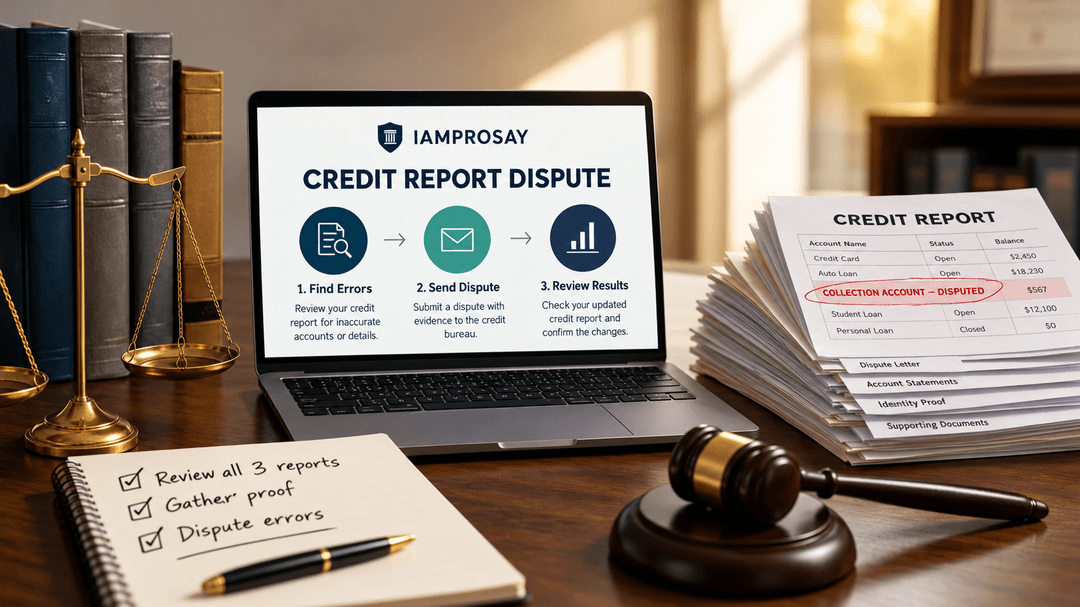
Here is how to remove inaccurate collections from your credit report: get your report from all three bureaus, collect proof that the account is wrong, and send a written dispute to both the credit bureau and the collector. Mail it by certified mail and keep copies. If the item cannot be verified, it has to be corrected or deleted.
The law gives you a clock to work with. Credit reporting companies must investigate disputed items, usually within 30 days, according to the Federal Trade Commission. The steps below show you how to start that clock the right way.
A collection is inaccurate when any part of what the report says is wrong, incomplete, or misleading. It does not have to be a complete mistake. A wrong balance is enough.
Here are the most common problems:
Read each entry slowly. People often spot the problem in a small detail, like a date or an account number.
Follow these in order. Each step builds the paper trail you may need later.
Get your reports from Equifax, Experian, and TransUnion. Each bureau can hold different information, so one clean report does not mean the others are. You can order your credit reports here, or use AnnualCreditReport.com for free copies.
Highlight each collection that looks wrong. Write down the collector’s name, account number, balance, and the date opened. Note exactly what is wrong with each one.
Proof is what separates a dispute that works from one that gets brushed off. Useful documents include:
Write one letter per bureau that lists the error. Say what is wrong, why, and what you want done. Attach copies of your proof, never the originals.
The credit bureau and the company that reports the information are both responsible for correcting errors. That company is called the furnisher. Send the collector its own letter, because a dispute that reaches both sides is harder to ignore. If you have never asked the collector to prove the debt, a debt validation letter is a smart companion step. florastuart
Send each letter by certified mail with a return receipt. Keep a copy of every letter, every attachment, and every receipt in one folder. Mark your calendar for 30 days from the date each bureau signs for your letter.
A good letter is short and specific. It names the item, explains the error, and asks for a clear action.
Include these details:
Here is a short example:
I am disputing the following item on my credit report: [Collector Name], account number [number], reported balance [amount]. This item is inaccurate because [the debt was paid on (date) / this is not my account / the balance includes fees I did not agree to]. I have enclosed copies of my proof. Please investigate, delete or correct this item, and send me the results along with an updated copy of my report.
Avoid long stories and angry language. A calm, factual letter gets read.
If you would like help with the wording, the guide on credit dispute letters walks through it.
The bureau forwards your dispute to the collector, which has to review it and report back. Most investigations wrap up in about 30 days. You will get the result by mail or email.
One of three things happens:
If you get “verified” and you still think it is wrong, you have options.
Also check that the disputed account shows as disputed on your report. That detail matters.
Generally, no. The FTC states that no one can legally remove accurate and timely negative information from a credit report. Anyone who promises to do so is a red flag. ftc
Here is what usually applies to accurate collections:
Before you pay anything, make sure the debt is accurate and that the collector can prove it. In some states, a payment can restart the clock on the statute of limitations.
These small errors slow people down more than anything else.
If you are hunting for a clean way to organize your dispute, start with this approach to how to remove inaccurate collections from your credit report one account at a time. Handle the clearest error first, then move on.
IAMPROSAY is a legal self-help platform that helps you build dispute documents around your situation. You answer plain questions about the collection, and your answers shape the letter. It is not a law firm, and its content is checked by attorney reviewers.
The Protect plan at $29 per month includes unlimited FDCPA and FCRA scans along with dispute and validation letters. You can also read the guide on credit report errors or learn more about debt collector help.
Generally about seven years from the first missed payment that led to the collection. Paying it does not restart that clock. If an old collection shows a newer date than it should, dispute it.
No. Filing a dispute does not lower your score. If the item is corrected or deleted, your score may go up.
Yes. All three bureaus have online dispute forms. A certified letter with proof attached is still the better record, so many people do both.
Not until you know the debt is accurate and the amount is right. A payment can sometimes be seen as acknowledging the debt. Check the details first.
Look at your evidence again. If you have new proof, file a new dispute. You can also add a statement of dispute to your file, send a complaint to the CFPB, or speak with an attorney.
Inaccurate collections do not fix themselves. A careful, written dispute with proof is the most reliable way to push back. Start with your three reports and mark what looks wrong.
If you want a hand with the letters, use the guided finder. Tell us what you found on your report, and we’ll point you to the dispute document that fits.